“Let me tell you a quick story about…”

No. Please don’t. Besides, you’re lying. It’s never quick. You tell stories like old people drive. Slow. They’re also painful. That’s what makes them torture. I beg you, stop.

I know, it’s really the fault of a lot of brilliant marketing minds, all of whom presented you with a idea that sounded great but which is only half true:

“It’s all about storytelling!”

The intent was to convey that audiences and buyers aren’t persuaded by laundry lists of features and benefits. Instead, a narrative with a beginning, middle, and satisfactory end is, in fact, a more effective way to communicate your value.

Here’s what was missing: No one gives a flying flip about YOUR story. They want to hear THEIR story. Or, at least, an idealized version of it.

A good story is relatable. Aspirational, even. But great stories? A great story is one in which your audience can truly see themselves, giving that main character energy and winning the day.

So each time you tell a story about you, your product, your experience, what you find interesting, they die a little inside. They. Don’t. Care. They don’t have time to care. They’re busy. A story that doesn’t add value for them actually subtracts value, because it robbed them of their time.

If you want to be interesting, find a way that makes your audience the hero of the story. The winner. The one who nailed the bad guys and got the girl. (Or vice versa!)

Just never make it about you. Please.

Messaging, positioning, and content–the building blocks of storytelling–align sales and marketing. I’m Jared A. Chambers, Brand Messaging and Smarketing Strategist, and I unite people, processes, and persuasive messaging to accelerate growth for B2B and tech companies. Connect with me to craft stories that sell.


While what’s revealed is interesting, it’s what’s concealed that matters.

To extend the metaphor, it’s always Spring Break at Panama City Beach for most marketers–gratuitous use of stats are as common a sight as a string bikini and often just as flimsy. Marketers live at the intersection of “justify your existence amid tightening budgets” and “be data-driven,” thus a lot of numbers they toss around are self-serving.

That doesn’t mean they’re maliciously deceitful. It’s the system itself that turns statistics into spin. When taking action without having a number to back it up will land you on the hot seat, you come up with a number. Businesses demand numbers to measure performance, yet they often don’t even know what those numbers should be. Bad management begets bad data.

Here are some clues your marketing stats are hiding more than they’re showing:

– The focus is on percentages and rates of change without showing the raw numbers.
– There’s an attempt to quantify what is inherently qualitative, and to objectify the inherently subjective.
– The sample group in relation to the whole is unclear.
– The assumptions made in collecting the data and the problems to be solved are unlisted and unclear.

The numbers should tell a story, but every story must have a beginning, a middle, and an end. Is it clear what the progression is when you see the latest report or dashboard?

While it won’t necessarily be a linear relationship, your marketing data should demonstrate a clear impact to sales results. It neither makes sense for the metrics to be self-created and reported nor for them to be arbitrary and assigned. Coming up with information that can be measured and managed towards the whole health of the business requires internal alignment of mission and message.

That’s whatSmarketing is all about. Alignment. This requires a holistic view of sales and marketing and a systems approach based in first principles. In other words, there must be leadership that can evaluate, facilitate, and formulate the baseline, the combined strategy, and the successful execution of tactics. Beginning, middle, and end–the full story, told in numbers that are mutually clear and meaningful.

Fortunately, I help growth businesses do exactly that. Are you ready for ALL to be revealed? I’m Jared A. Chambers, Brand Messaging and Smarketing Strategist, and unite people, processes, and persuasive messaging to accelerate growth for small and mid-market B2B and tech businesses. Contact me to peel the layers.

My local networking often puts me in the company of exceptional entrepreneurs and exceptional marketers.

In talking to both, two things stand out:

1. Business owners’ questions and concerns frequently focus on marketing tactics. Specifically, what should they be executing to grow their business and how can they leverage experts to do so?
2. The market is vibrant with experts in every tactic and medium, from SEO/GEO to video production to media creation to campaigns to… well, it’s really as endless as the number of experts themselves, as everyone naturally tends to specialize in increasingly niche and finite ways.

The good news is, there’s help for any type of marketing execution, with the only limit being your ability and willingness to pay. You say you need a skilled expert? Let me swing a dead cat–I’ll hit a dozen in my inner circle for you to call, from web developers to social media managers to any other specialization you can ask for.

But might I suggest, the reason choosing one is often so daunting isn’t a lack of options. It’s too many options when you don’t really understand what questions you need to ask.

What I mean is this: not all web design is the same, nor is online content creation or branding or graphics or anything else, either in function or audience.

To ask the right questions about marketing tactics to allow you to sort through almost limitless options is to do marketing strategy first. And, you’ll be pleased to learn, there are a lot of experts in that, as well.

You have to view the system at the most expansive level: You market so that you can sell. You must identify who can and should buy from you, and connect with them through the noise of other options in that market.

Only the Smarketing approach aligns these two inextricably linked areas, not just creating better marketing strategies, but also refining your sales process to align with your potential buyers. It’s more information leading to better strategy, resulting in better communication, which becomes better feedback, all culminating in more efficient and frictionless execution. Smarketing isn’t just tinkering with tactical execution or simply a new approach to strategy. It’s purposefully building a singular revenue engine for your business from the ground up.

I’m Jared A. Chambers, Brand Messaging and Smarketing Strategist, and I unite people, processes, and persuasive messaging to accelerate growth. If you own, lead, or manage the sales and marketing of a small to mid-market B2B firm that is poised for the next stage of growth, let’s talk, and I’ll show how you could be improving win rates, revenue, and profitability.

If nothing else, LinkedIn is always good for banal debates that entirely miss a larger point. A recurring favorite is about what is and is not “marketing.” There are marketing execs bogged down in field tactics arguing that being asked to create slide decks and proposals isn’t marketing, because sales enablement is downstream of marketing strategy. On the other hand, there are specialists and creatives fighting to preserve the artistry of their particular craft who don’t want to be saddled with the KPIs and metrics of “data-driven” marketing.

And there’s always just ego… people in jobs where they feel like they’re being asked to stoop too low below or stretch too high above their comfort zone. “That’s not marketing” is just a new way of saying the old thing: “That’s not my job!”

Well, actually….

It’s all marketing.

It’s all your job.

But it doesn’t stop there:

It’s all SMARKETING.

Yes, marketing will always have tactical and strategic roles that sometimes stand alone and also integrate into the broader system. Still, some fight for marketing to remain siloed from sales. It’s the same ego-driven and protectionist mindset.

These silos are all points of friction in a process that should singular purpose: to connect your business with your ideal customer, allowing you to convey your unique value in the market and establish a profitable business relationship of mutual value.

Smoothing the silos into a seamless process to fulfill this purpose requires leadership and objectivity that can see the system at the highest possible level, a person who understands each piece of the process both strategically and tactically. 

You need a leader. A strategy. A system.

I’m Jared A. Chambers, and I unite people, processes, and persuasive messaging to accelerate growth. I work directly with sales and marketing teams to bring them together as a singular revenue engine. As one team, we can identify and document roles and responsibilities in a way that gets past ego and actually feels empowering and productive. Smarketing recognizes individual talent and ability while stressing that everyone has one job: to attract, win, and delight customers.

Success requires ego and force of will–otherwise, any sane person can come up with plenty of reasons to give up. To you, it may seem like arrogance, but you can’t underestimate the beatings one must endure to step outside the path of ordinary in search of extraordinary.

In my work with high-functioning leaders, I’ve discovered two truths:

  • Ego is absolute, not relative. If they’ve arrived at what they think of as “success,” they have the same ego.
  • Success is relative, not absolute. No matter what they accomplish, there’s an objectively greater combination of money, power, and notoriety one can achieve and that someone else probably already has.

Let me tell you the good news first: No one truly has any competition other than themselves. Rise to your own standards. You don’t have to chase anyone’s vision but your own.

That said, absolute ego and relative success can create a blind spot for those who desire to rise to the next challenge. Once you achieve a goal, the smart and the not-so-smart things you did in getting there average out. If you reverse-engineer your roadmap to success, it won’t always be obvious what was an essential step and what was an unnecessary detour

Did you make three moderately smart choices, or two really smart choices and one stupid one? It’s often hard to tell if you could’ve been even more successful or achieved a goal more quickly. (This is why I don’t agree with the advice to only take advice from someone who’s succeeded at what you wish to accomplish. Successful people dole out bad advice all the time, because they don’t recognize what actually hindered them.)

The most important thing to recognize is that what you did only got you to where you are. So, raising the bar for yourself will require you to shift gears.

This is why I’m an evangelist for the smarketing approach for growth-stage businesses. Things like grit, passion, good products, a tight-knit team–they can all be part of a successful startup. But once you’re in a space where your competitors have similar qualities, you must differentiate even more and identify the things which have been creating drag on your business’s potential.

As a fractional, I’m a smarketing expert, at scale to your stage of growth. I also provide an objective viewpoint, even a bit of sandpaper, removed from company politics. I specialize in challenging convention and finding blind-spots. Don’t be a victim of your own success–let’s talk!

Some say the sales process is a funnel, with leads going in a hopper and coming out as closed deals. Others say it’s a pipeline, with potential deals flowing through.

Funnels and pipelines are fine for fluid mechanics, but they fall short in describing how buyers actually buy. Most importantly, they fail to show us how and why most potential deals with qualified, serious buyers are lost.

Because we assume most of the buying decision is made during our sales process, we’re often blind to how and why we’re losing qualified buyers.

The first place we lose them is before we even know they exist. Right now, there is a qualified, ready buyer for your solution that you will never meet, talk to, or plug into your CRM. When they started evaluating solutions and doing their homework, your brand either didn’t show up at all or it wasn’t positioned as a category leader. Even if you call that buyer today, you’ve already lost. You’re either invisible or a high-risk also-ran that didn’t make the short list.

The second place you lose them, as a general category, is anywhere your sales process creates friction:

  • Sales messaging that conflicts with marketing messaging.
  • Bureaucratic bottlenecks.
  • Disruptions in their own buying process and timing.

We call buyers “decision makers” for good reason: Decision makers DECIDE whether you’re worthy of consideration, and they DECIDE when and how to exit the process. Pushing them doesn’t work. You have to pull them in and pull them through.

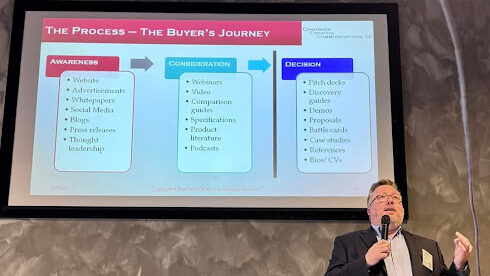
That pull approach is the essence of smarketing–aligning sales and marketing to support inbound processes and reflect the modern buyer’s journey. That requires a brand strategy that positions and messages you as a category leader, content that delivers that brand message to the right buyers at the right time, and sales enablement that provides processes, tools, and education for your team to follow consistently to success.

As a smarketing expert, I make sure you capture the buyers you didn’t know were out there, and I ensure you don’t lose them by removing the friction.

BRASELTON, GA – On September 26th, Chambers Creative Communications, LC appeared at the second annual Business Expo hosted at the Braselton Civic Center by Leather & Lace Events. The Expo played host to some 33 vendors representing businesses large, small, and even solo practitioners. Of these, there were several sponsoring vendors, of which Chambers Creative Communication sponsored at the Broze tier.

Free to attend for the local community, people filtered through the halls from 10-4 to learn more about these businesses and their offerings. As well, the business owners and representatives had ample opportunity to network with each other.

Jared A. Chambers, owner and Sales Enablement Strategist at Chambers Creative Communication, had this to say, “It’s always a pleasure to meet new people and share with them the message of sales and marketing alignment that we call “smarketing.” As well, the Expo proved to be an excellent investment of time and resources in growing the business.”

At the expo, Chambers provided a hit with Northeast Georgia Business Radio X, which is linked here.


The battle is not human versus AI when it comes to gold-level content.

Rather, it’s strategic, consistent, customer-centric information that helps buyers clarify choices versus obligatory “checklist” filler produced as a form of marketing window-dressing.

AI will certainly be employed to do much of the latter. Imagine: CEO goes to a workshop or reads an article about “content strategy,” says “we need that,” then puts it on Marketing’s plate without any specific budget or plan. So, someone in house who already doesn’t have the time gets stretched too thin, or it’s handed off to the low-bidding freelance “copywriter.” But wait! 2025 comes along and offers a third option: churn it out with AI.

But the result is always the same: Content is a marginal quality afterthought, produced merely to keep up with the corporate Joneses. It doesn’t compel a potential buyer to actually do anything, because it isn’t aligned to their needs or desires. It doesn’t give them a window into their potential future. IT DOESN’T HELP THEM MAKE A DECISION.

Machines didn’t cause this. People did.

When “creating content” becomes a goal unto itself, with a scarcity mindset behind it, companies produce garbage content. Some insource their garbage. Others outsource their garbage. Now, some are beginning to automate their garbage.

But GARBAGE is not the product of who or what created it, rather the mindset and (lack of) strategy behind it.

Change the paradigm. Change the results.

Your content library is a continuous chain that links your solutions to the needs of your customers, allowing them to follow their journey right into your sales pipeline. It’s not merely a marketing task to be checked-off, it is a sales strategy that will level-up the lead generation, conversions, closings, and profit of your entire team.

Assign a real budget, calendar, and goals to content creation, and with that, a strategy. Execute that strategy in house, with outside help, or even with AI assistance–it’s not the means that matter. Alignment and strategy is what makes your content gold instead of garbage.

Time is the enemy of every deal.

In my sales career, I always worked long-cycle deals that are typical of B2B tech sales. Still, I had some unusually, painfully long deals in which I finally won. There will be delays you just can’t control when dealing with complex solutions and multiple stakeholders. But in general, the longer the window from interest to decision, the more likely it is that you’ll lose the deal. Time can be a strategic stall from a customer used for leverage. Or, it can just be an otherwise pointless delay that let the client’s doubts creep in or a new competitor to emerge. Your job as a salesperson or managing a sales organization is to keep things moving forward.

The way you combat introducing extra time into the deal cycle is two-fold:

1. You need systems. There needs to be a default method for doing EVERYTHING. Outreach. Follow-up. Quoting. Sending info. Presenting. Of course, you CAN tailor your method if the situation calls for it. But the last position you want to be in is not knowing exactly what’s supposed to happen next, especially when the customer demonstrates willingness and desire to move forward. If the prospect is asking you for information, pricing, a demo, whatever–you will plant the seed of “yes” or “no” in your response. If you seem uncertain, your prospect will be uncertain. Uncertainty = risk. Risk = reason to say “no.”

2. You need to optimize every system to reduce friction. I always say that any system beats no system, but that doesn’t mean there aren’t a lot of inefficient systems that are killing deals. The same principle is in play. If the prospect or customer hits a bottleneck, he or she has time to reconsider things or have circumstances change. A bottleneck will never help you get to “yes;” it can only hurt. That’s why your sales process should be mapped to your buyer’s journey. As well, necessary but frustrating administrative red tape like legal reviews need to be streamlined, and everyone from marketing and sales must be using a unified messaging framework. Otherwise you’re introducing friction. Friction = slowdowns and time. Time = uncertainty. Uncertainty = risk. Risk = (You’ll remember this!) a reason to say “no.”

I can help your growth business align sales and marketing (It’s called smarketing!) to win the battle against TIME. That means more opportunities, closed faster, which brings you greater revenue at higher profit margins–the goal and result of effective sales enablement.