Success requires ego and force of will–otherwise, any sane person can come up with plenty of reasons to give up. To you, it may seem like arrogance, but you can’t underestimate the beatings one must endure to step outside the path of ordinary in search of extraordinary.

In my work with high-functioning leaders, I’ve discovered two truths:

  • Ego is absolute, not relative. If they’ve arrived at what they think of as “success,” they have the same ego.
  • Success is relative, not absolute. No matter what they accomplish, there’s an objectively greater combination of money, power, and notoriety one can achieve and that someone else probably already has.

Let me tell you the good news first: No one truly has any competition other than themselves. Rise to your own standards. You don’t have to chase anyone’s vision but your own.

That said, absolute ego and relative success can create a blind spot for those who desire to rise to the next challenge. Once you achieve a goal, the smart and the not-so-smart things you did in getting there average out. If you reverse-engineer your roadmap to success, it won’t always be obvious what was an essential step and what was an unnecessary detour

Did you make three moderately smart choices, or two really smart choices and one stupid one? It’s often hard to tell if you could’ve been even more successful or achieved a goal more quickly. (This is why I don’t agree with the advice to only take advice from someone who’s succeeded at what you wish to accomplish. Successful people dole out bad advice all the time, because they don’t recognize what actually hindered them.)

The most important thing to recognize is that what you did only got you to where you are. So, raising the bar for yourself will require you to shift gears.

This is why I’m an evangelist for the smarketing approach for growth-stage businesses. Things like grit, passion, good products, a tight-knit team–they can all be part of a successful startup. But once you’re in a space where your competitors have similar qualities, you must differentiate even more and identify the things which have been creating drag on your business’s potential.

As a fractional, I’m a smarketing expert, at scale to your stage of growth. I also provide an objective viewpoint, even a bit of sandpaper, removed from company politics. I specialize in challenging convention and finding blind-spots. Don’t be a victim of your own success–let’s talk!

Some say the sales process is a funnel, with leads going in a hopper and coming out as closed deals. Others say it’s a pipeline, with potential deals flowing through.

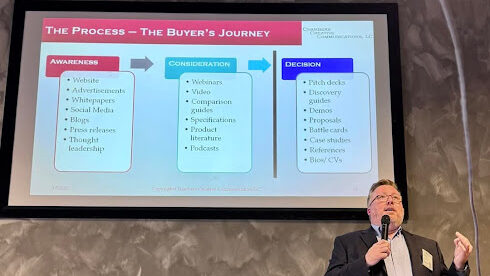
Funnels and pipelines are fine for fluid mechanics, but they fall short in describing how buyers actually buy. Most importantly, they fail to show us how and why most potential deals with qualified, serious buyers are lost.

Because we assume most of the buying decision is made during our sales process, we’re often blind to how and why we’re losing qualified buyers.

The first place we lose them is before we even know they exist. Right now, there is a qualified, ready buyer for your solution that you will never meet, talk to, or plug into your CRM. When they started evaluating solutions and doing their homework, your brand either didn’t show up at all or it wasn’t positioned as a category leader. Even if you call that buyer today, you’ve already lost. You’re either invisible or a high-risk also-ran that didn’t make the short list.

The second place you lose them, as a general category, is anywhere your sales process creates friction:

  • Sales messaging that conflicts with marketing messaging.
  • Bureaucratic bottlenecks.
  • Disruptions in their own buying process and timing.

We call buyers “decision makers” for good reason: Decision makers DECIDE whether you’re worthy of consideration, and they DECIDE when and how to exit the process. Pushing them doesn’t work. You have to pull them in and pull them through.

That pull approach is the essence of smarketing–aligning sales and marketing to support inbound processes and reflect the modern buyer’s journey. That requires a brand strategy that positions and messages you as a category leader, content that delivers that brand message to the right buyers at the right time, and sales enablement that provides processes, tools, and education for your team to follow consistently to success.

As a smarketing expert, I make sure you capture the buyers you didn’t know were out there, and I ensure you don’t lose them by removing the friction.

BRASELTON, GA – On September 26th, Chambers Creative Communications, LC appeared at the second annual Business Expo hosted at the Braselton Civic Center by Leather & Lace Events. The Expo played host to some 33 vendors representing businesses large, small, and even solo practitioners. Of these, there were several sponsoring vendors, of which Chambers Creative Communication sponsored at the Broze tier.

Free to attend for the local community, people filtered through the halls from 10-4 to learn more about these businesses and their offerings. As well, the business owners and representatives had ample opportunity to network with each other.

Jared A. Chambers, owner and Sales Enablement Strategist at Chambers Creative Communication, had this to say, “It’s always a pleasure to meet new people and share with them the message of sales and marketing alignment that we call “smarketing.” As well, the Expo proved to be an excellent investment of time and resources in growing the business.”

At the expo, Chambers provided a hit with Northeast Georgia Business Radio X, which is linked here.


The battle is not human versus AI when it comes to gold-level content.

Rather, it’s strategic, consistent, customer-centric information that helps buyers clarify choices versus obligatory “checklist” filler produced as a form of marketing window-dressing.

AI will certainly be employed to do much of the latter. Imagine: CEO goes to a workshop or reads an article about “content strategy,” says “we need that,” then puts it on Marketing’s plate without any specific budget or plan. So, someone in house who already doesn’t have the time gets stretched too thin, or it’s handed off to the low-bidding freelance “copywriter.” But wait! 2025 comes along and offers a third option: churn it out with AI.

But the result is always the same: Content is a marginal quality afterthought, produced merely to keep up with the corporate Joneses. It doesn’t compel a potential buyer to actually do anything, because it isn’t aligned to their needs or desires. It doesn’t give them a window into their potential future. IT DOESN’T HELP THEM MAKE A DECISION.

Machines didn’t cause this. People did.

When “creating content” becomes a goal unto itself, with a scarcity mindset behind it, companies produce garbage content. Some insource their garbage. Others outsource their garbage. Now, some are beginning to automate their garbage.

But GARBAGE is not the product of who or what created it, rather the mindset and (lack of) strategy behind it.

Change the paradigm. Change the results.

Your content library is a continuous chain that links your solutions to the needs of your customers, allowing them to follow their journey right into your sales pipeline. It’s not merely a marketing task to be checked-off, it is a sales strategy that will level-up the lead generation, conversions, closings, and profit of your entire team.

Assign a real budget, calendar, and goals to content creation, and with that, a strategy. Execute that strategy in house, with outside help, or even with AI assistance–it’s not the means that matter. Alignment and strategy is what makes your content gold instead of garbage.

Time is the enemy of every deal.

In my sales career, I always worked long-cycle deals that are typical of B2B tech sales. Still, I had some unusually, painfully long deals in which I finally won. There will be delays you just can’t control when dealing with complex solutions and multiple stakeholders. But in general, the longer the window from interest to decision, the more likely it is that you’ll lose the deal. Time can be a strategic stall from a customer used for leverage. Or, it can just be an otherwise pointless delay that let the client’s doubts creep in or a new competitor to emerge. Your job as a salesperson or managing a sales organization is to keep things moving forward.

The way you combat introducing extra time into the deal cycle is two-fold:

1. You need systems. There needs to be a default method for doing EVERYTHING. Outreach. Follow-up. Quoting. Sending info. Presenting. Of course, you CAN tailor your method if the situation calls for it. But the last position you want to be in is not knowing exactly what’s supposed to happen next, especially when the customer demonstrates willingness and desire to move forward. If the prospect is asking you for information, pricing, a demo, whatever–you will plant the seed of “yes” or “no” in your response. If you seem uncertain, your prospect will be uncertain. Uncertainty = risk. Risk = reason to say “no.”

2. You need to optimize every system to reduce friction. I always say that any system beats no system, but that doesn’t mean there aren’t a lot of inefficient systems that are killing deals. The same principle is in play. If the prospect or customer hits a bottleneck, he or she has time to reconsider things or have circumstances change. A bottleneck will never help you get to “yes;” it can only hurt. That’s why your sales process should be mapped to your buyer’s journey. As well, necessary but frustrating administrative red tape like legal reviews need to be streamlined, and everyone from marketing and sales must be using a unified messaging framework. Otherwise you’re introducing friction. Friction = slowdowns and time. Time = uncertainty. Uncertainty = risk. Risk = (You’ll remember this!) a reason to say “no.”

I can help your growth business align sales and marketing (It’s called smarketing!) to win the battle against TIME. That means more opportunities, closed faster, which brings you greater revenue at higher profit margins–the goal and result of effective sales enablement.

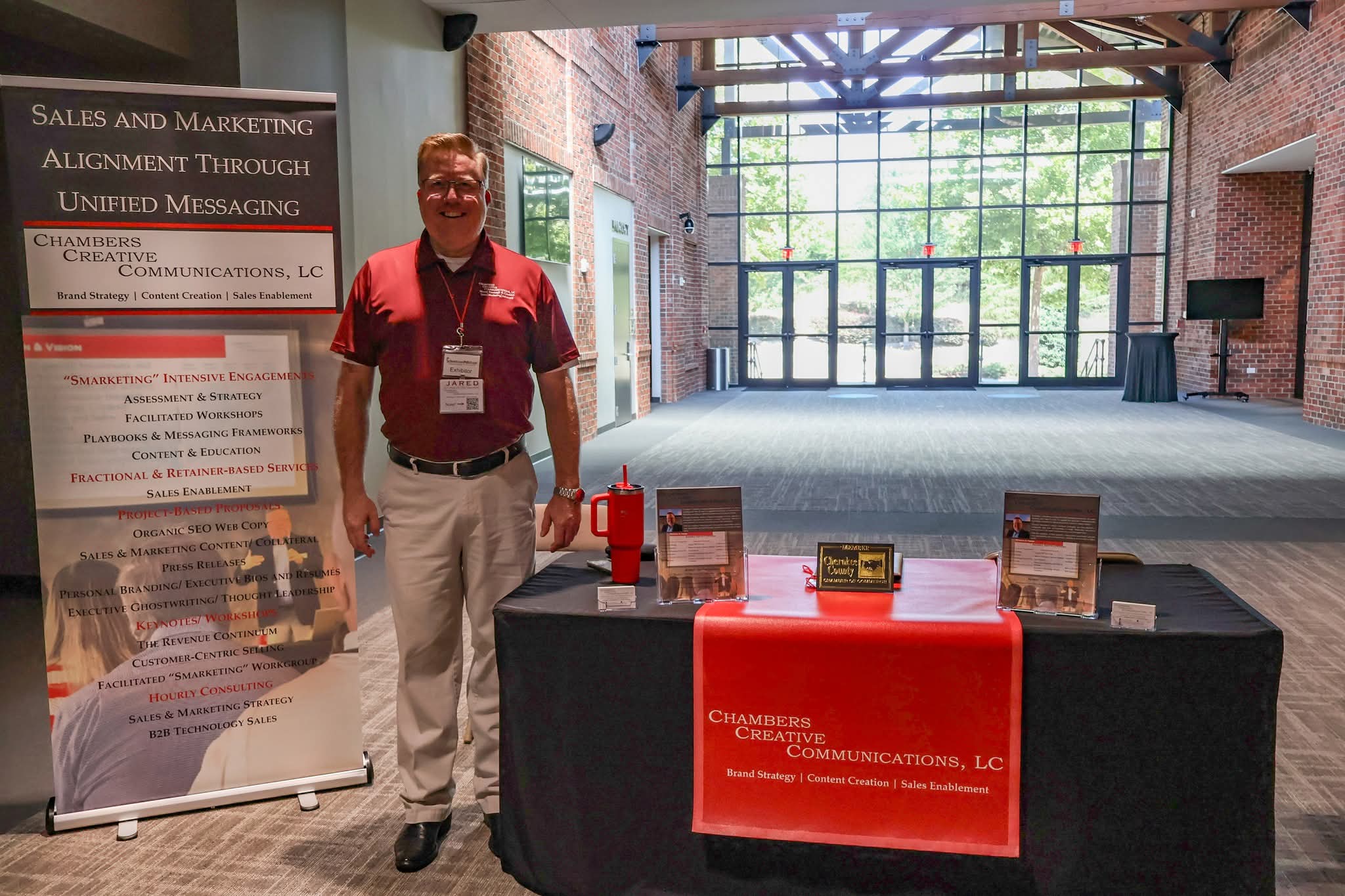
WOODSTOCK, GA — Chambers Creative Communications, LC exhibited on August 14th at the annual Cherokee Chamber of Commerce “Schmooza-Palooza,” the largest networking event organized by the Chamber. Chambers Creative Communications was one of 67 vendors on hand, with owner Jared A. Chambers discussing Sales Enablement with attendees as well as evangelizing the concept of “smarketing,” or sales and marketing alignment to better address buying processes and attitudes of modern customers and clients.

For Chambers Creative Communications, this was the second of three major summer events, which began with the sponsored breakfast at Crabapple Business Club in July and will conclude with the official Ribbon Cutting with the Cherokee Chamber of Commerce on September 16th.

These events are designed to build momentum for the next phase of Chambers Creative Communications in its second year, focusing more on local education and events for area businesses as well as establishing ongoing sales enablement and smarketing engagements and retainers with top established businesses ready to accelerate their growth.

Please make sure to keep an eye on events on our Resources page!

Chambers Creative Communication exhibit at Schmooza-Palooza