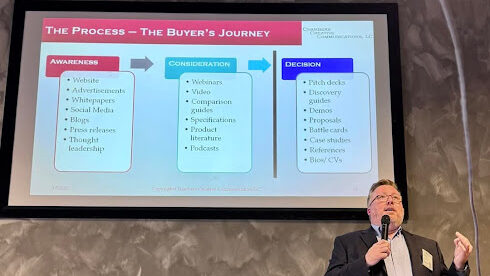
Some say the sales process is a funnel, with leads going in a hopper and coming out as closed deals. Others say it’s a pipeline, with potential deals flowing through.
Funnels and pipelines are fine for fluid mechanics, but they fall short in describing how buyers actually buy. Most importantly, they fail to show us how and why most potential deals with qualified, serious buyers are lost.
Because we assume most of the buying decision is made during our sales process, we’re often blind to how and why we’re losing qualified buyers.
The first place we lose them is before we even know they exist. Right now, there is a qualified, ready buyer for your solution that you will never meet, talk to, or plug into your CRM. When they started evaluating solutions and doing their homework, your brand either didn’t show up at all or it wasn’t positioned as a category leader. Even if you call that buyer today, you’ve already lost. You’re either invisible or a high-risk also-ran that didn’t make the short list.
The second place you lose them, as a general category, is anywhere your sales process creates friction:
- Sales messaging that conflicts with marketing messaging.
- Bureaucratic bottlenecks.
- Disruptions in their own buying process and timing.
We call buyers “decision makers” for good reason: Decision makers DECIDE whether you’re worthy of consideration, and they DECIDE when and how to exit the process. Pushing them doesn’t work. You have to pull them in and pull them through.
That pull approach is the essence of smarketing–aligning sales and marketing to support inbound processes and reflect the modern buyer’s journey. That requires a brand strategy that positions and messages you as a category leader, content that delivers that brand message to the right buyers at the right time, and sales enablement that provides processes, tools, and education for your team to follow consistently to success.
As a smarketing expert, I make sure you capture the buyers you didn’t know were out there, and I ensure you don’t lose them by removing the friction.